
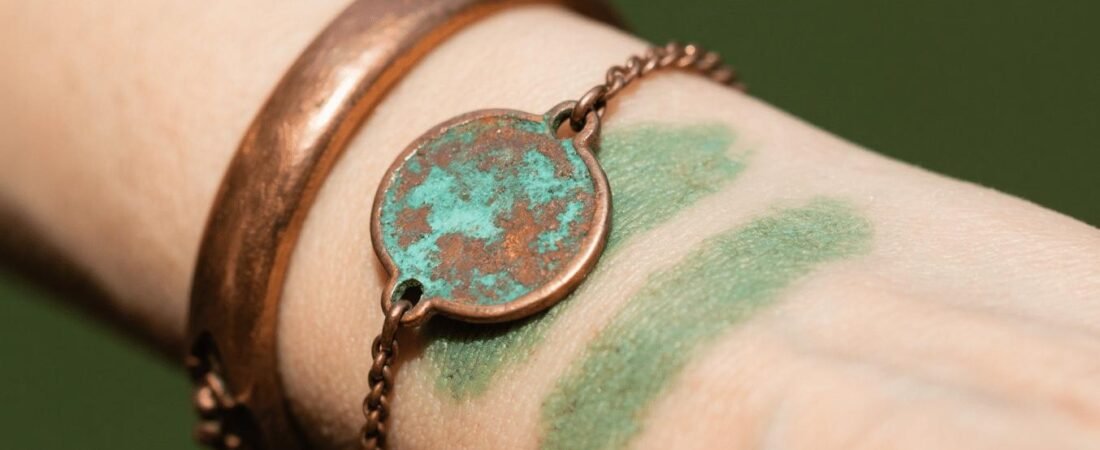
What Are the Benefits of Copper on Skin?
Copper is not an essential trace mineral that your body needs to function.
When it comes to copper benefits on skin, research shows that copper plays a role in:
- Supporting collagen and elastin production (skin strength and elasticity) (PMC)
- Acting as an antioxidant, helping reduce oxidative stress (Linus Pauling Institute)
- Assisting in tissue repair and regeneration (PMC)
- Supporting enzymes that maintain overall skin structure
In simple terms:
Copper doesn’t “fix” your skin directly—it supports the biological systems that keep skin healthy.
Why Does Copper Turn Skin Green?

One of the most searched questions is:
“Why does copper turn my skin green?”
Here’s the real answer:
- Copper reacts with sweat, oils, and air
- This creates compounds like copper salts
- These can leave a temporary green mark on skin
This process is called oxidation.
👉 Important:
- It is not harmful
- It is not toxicity
- It washes off easily
It simply means the copper is real and reactive.
What Is Copper Patina? (And Why It’s a Good Sign)
Copper patina is the natural layer that forms over time.
Stages of copper oxidation:
- Fresh copper → shiny orange
- Early oxidation → darker brown
- Advanced patina → green/blue (verdigris)
This happens because copper constantly reacts with:
- Oxygen
- Moisture
- Skin chemistry
👉 Patina is:
- A natural protective layer
- A sign of authentic copper
- A reflection of how the metal interacts with you
That’s why every piece becomes unique over time.
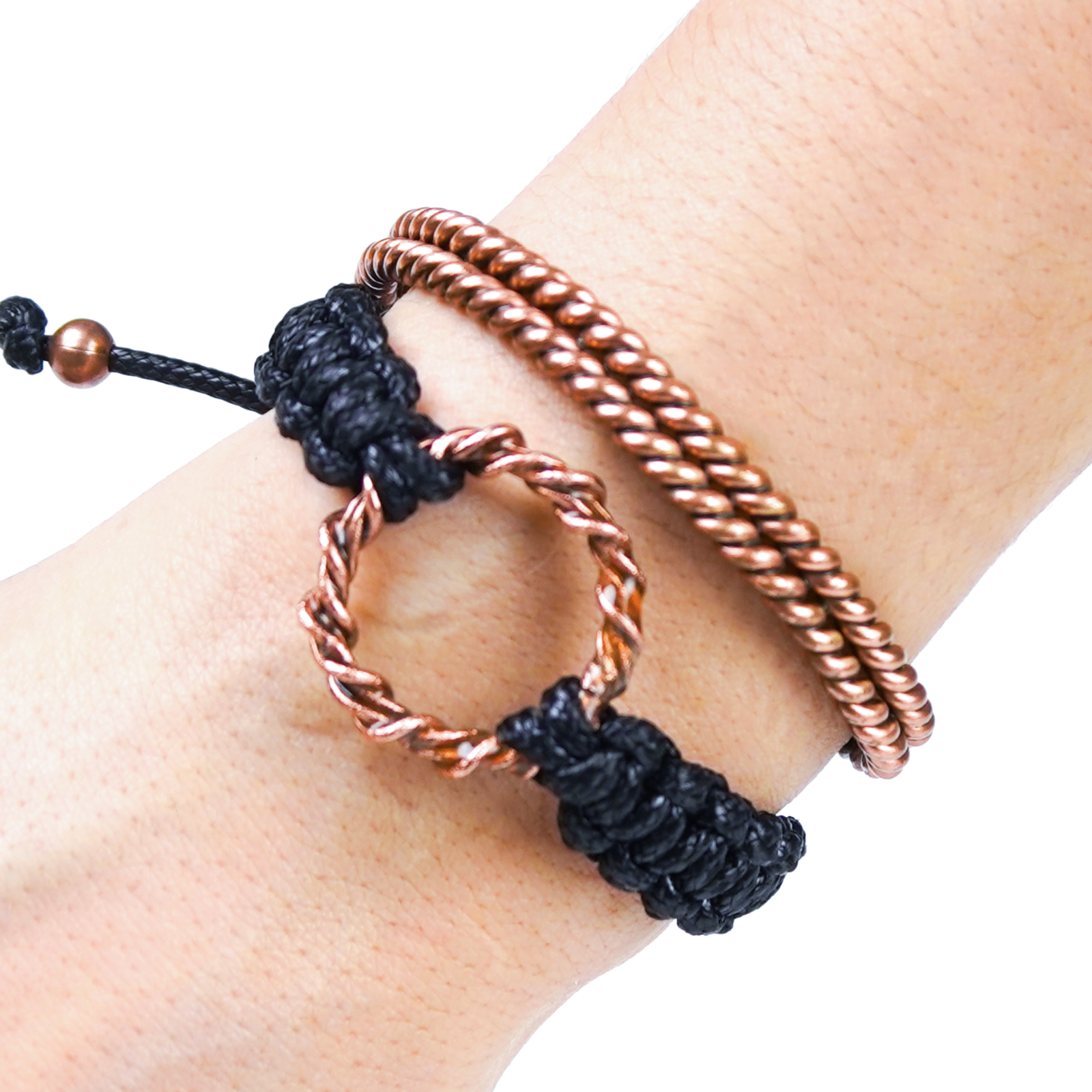
Copper Tensor Ring Bracelets | Energy Field Stabilizer
A wearable “Do Not Disturb” field for your aura.
Copper and the Nervous System (The Electrical Truth)

Another major topic people search is:
“Does copper conduct energy in the body?”
Here’s the grounded explanation.
Your body is an electrochemical system.
Every signal in your brain and body depends on electrical activity.
Copper plays a key role in that system:
- Acts as a cofactor for enzymes involved in energy production (Linus Pauling Institute)
- Supports neurotransmitter synthesis (brain signaling chemicals) (CloudFront)
- Helps maintain the nervous system and brain function (Medical News Today)
- Participates in electron transfer processes inside cells (Wikipedia)
👉 Key takeaway:
Copper doesn’t act like a wire in your body—but it enables the processes that allow electrical signaling to happen.
Is Copper Good for Skin Health?
Short answer: Yes—within normal exposure and biology.
Copper contributes to:
- Skin structure (collagen cross-linking) (Wikipedia)
- Cellular energy production
- Antioxidant defense systems
- Blood vessel formation and oxygen flow (Medical News Today)
This is why copper appears in:
- Skincare ingredients
- Medical textiles
- Traditional wearable items
Is Copper on Skin Safe?
For most people:
✅ Safe for daily wear
✅ Non-toxic in normal contact
✅ Naturally antimicrobial on surfaces (Wikipedia)
However:
- Some people may have sensitive skin
- Prolonged moisture + friction can increase marks
- Rare allergies can occur
👉 If irritation appears, simply remove the piece.
Copper Oxidation on Skin: Why Everyone Reacts Differently
Not everyone gets green marks.
That depends on:
- Skin pH
- Sweat composition
- Diet and mineral balance
- Environment (humidity, heat)
That’s why:
- One person sees strong patina
- Another sees almost none
The Real Perspective on Copper
Copper sits at a unique intersection:
- Material world → electrical conductor
- Biological world → enzyme cofactor
- Visible world → patina and oxidation
It is:
- Reactive
- Functional
- Alive in interaction
Final Thought
If you’re searching for:
- “Copper benefits skin”
- “Why copper turns skin green”
- “Copper oxidation on skin”
- “Copper and nervous system electricity”
The truth is simple:
Copper is not magic.
But it is deeply functional, biologically relevant, and naturally interactive.
And when you wear it,
you’re not just wearing a metal—you’re wearing a material that responds to you.